
Solar vs. Power Banks: A data-driven look at which charging method actually wins on a five-day trek
The ultimate hiking showdown: solar panels or power banks? We break down the data to see which is the best way to keep your gear charged on a long-haul trek.
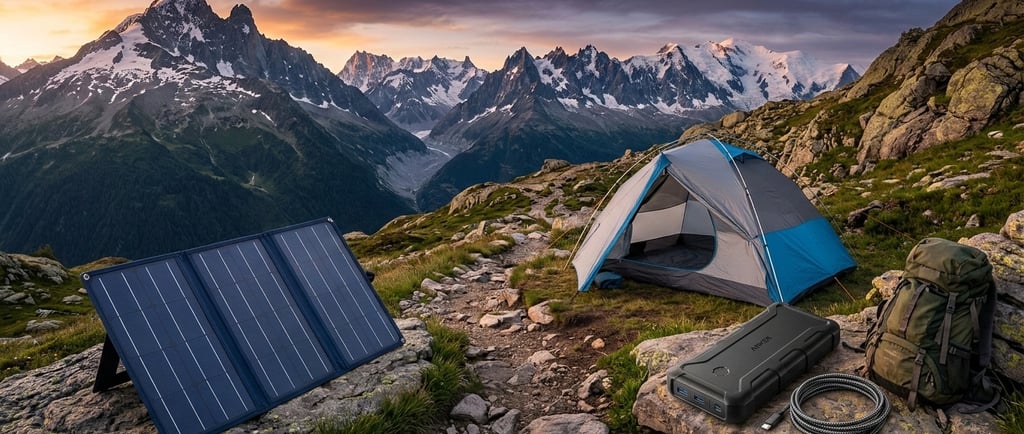
The classic dilemma for any long-distance hiker: how to keep the essential electronics—phone, GPS, headlamp—juiced up. The two main options are a solar charger and a power bank. Both have their proponents and their merits. But when it comes down to a five-day trek, which one is truly the superior choice? Let's look at the data to find out.
The Power Bank: The Reliable Workhorse
A power bank is essentially a big battery that you charge at home and then use to charge your devices on the trail. Its key advantages are simplicity and reliability. You know exactly how much power you have, and you don’t have to rely on external factors like the weather.
The primary disadvantage is that once a power bank is empty, it's just dead weight. You have to carry that weight for the remainder of your trip. The power bank you choose will need to be large enough to last for the duration of your trek. For a five-day trip, a power bank with at least 10,000mAh capacity is a solid starting point.
Power Bank Data Point:
Capacity: 10,000mAh (This is a common and versatile size for a multi-day hike).
Charging Capability: A 10,000mAh bank can typically charge a standard smartphone (with an approx. 3,000mAh battery) about 2.5 to 3 times, considering inefficiency and power loss during charging.
Weight: Around 6-8 ounces for a good 10,000mAh bank.
The Bottom Line: For a five-day trek, a 10,000mAh power bank provides a finite, predictable amount of power. It's a "known quantity." If your power needs are moderate (e.g., occasional phone use, a couple of GPS checks a day), this is often the simplest and most reliable solution.
Popular Choice: The Anker PowerCore 10000 is a classic, lightweight, and reliable option for hikers.
The Solar Charger: The Off-Grid Power Plant
A solar charger uses photovoltaic cells to convert sunlight into electricity, which is then used to charge your devices directly or (more efficiently) to charge a power bank. The main advantage is that it provides an potentially infinite source of power, as long as there is sunlight. This is a huge benefit for long trips where a power bank might run out.
The obvious disadvantage is its dependence on weather and environmental factors. On a cloudy day or under heavy tree cover, your charging capacity will be severely limited, or even non-existent. Solar chargers are also typically heavier and more fragile than power banks.
Solar Charger Data Point:
Wattage: For backpacking, a 10-20W panel is a common choice, offering a good balance of power and portability.
Charging Speed: Under ideal conditions (direct, intense, midday sun), a 10W panel can charge a typical smartphone in 2-4 hours. However, in real-world conditions (on-and-off sun, changing angles, tree cover), this can easily be 2-3 times longer.
Real-World Application: Most experienced users combine a solar panel with a smaller power bank. You use the panel to charge the bank during the day, and then use the bank to charge your devices at night. This smooths out the power flow and provides a crucial backup for cloudy days.
Weight: A 10W panel might weigh 10-14 ounces.
The Bottom Line: A solar charger offers independence and the potential for unlimited power. However, it requires a lot more active management (frequently adjusting its position to face the sun) and is less predictable than a power bank. For a five-day trek in a notoriously sunny area, it can be a fantastic choice. In a region with unpredictable weather, it could become frustration-inducing dead weight.
Popular Choice: The BigBlue 3 28W Solar Charger is known for its high efficiency and rugged design.
The Verdict: Who Wins on a Five-Day Trek?
Let’s be direct: The power bank is the winner for the vast majority of hikers on a five-day trek.
Here’s why, backed by the data:
Predictability and Reliability: With a power bank, you know exactly what you're working with. You have a finite, measurable amount of power. On a relatively short trip like five days, that reliability is invaluable. A solar panel’s output is a variable, and that’s a risk most hikers don’t need to take on a short excursion.
Ease of Use: A power bank requires zero thought or maintenance on the trail. You plug in your device, and it charges. A solar panel requires constant attention and positioning to be effective. Hiking is meant to be an escape from that kind of active management.
Weight Efficiency for Short Trips: For five days, the weight of a 10,000-15,000mAh power bank is likely comparable to, or even lighter than, a solar panel and a smaller backup power bank (which is the necessary, realistic solar setup). The solar system only becomes weight-efficient on much longer trips where the weight of additional power banks would surpass that of the solar kit.
When is Solar the Right Choice?
The solar charger has its place, and it truly shines in specific scenarios:
Longer Treks: For trips of 10-14 days or longer, the weight of multiple power banks becomes substantial. At that point, a solar panel combined with a small power bank can become a more efficient setup.
Consistent Sun: If your trek takes you through a high-altitude desert or other environment with near-guaranteed, intense sun for most of the trip, solar can be a reliable and powerful choice.
Basecamping: If your "trek" involves day-hiking from a central location where you can leave a solar panel out all day in prime position, it works perfectly.
For your typical five-day mountain or forest trek, save yourself the hassle, weight, and uncertainty. A quality power bank is the smart, data-supported choice for reliable power from the trailhead to your final camp.
As an Amazon Associate I earn from qualifying purchases.
© 2026. All rights reserved.


Gear Up. Head Out. Hike On.